
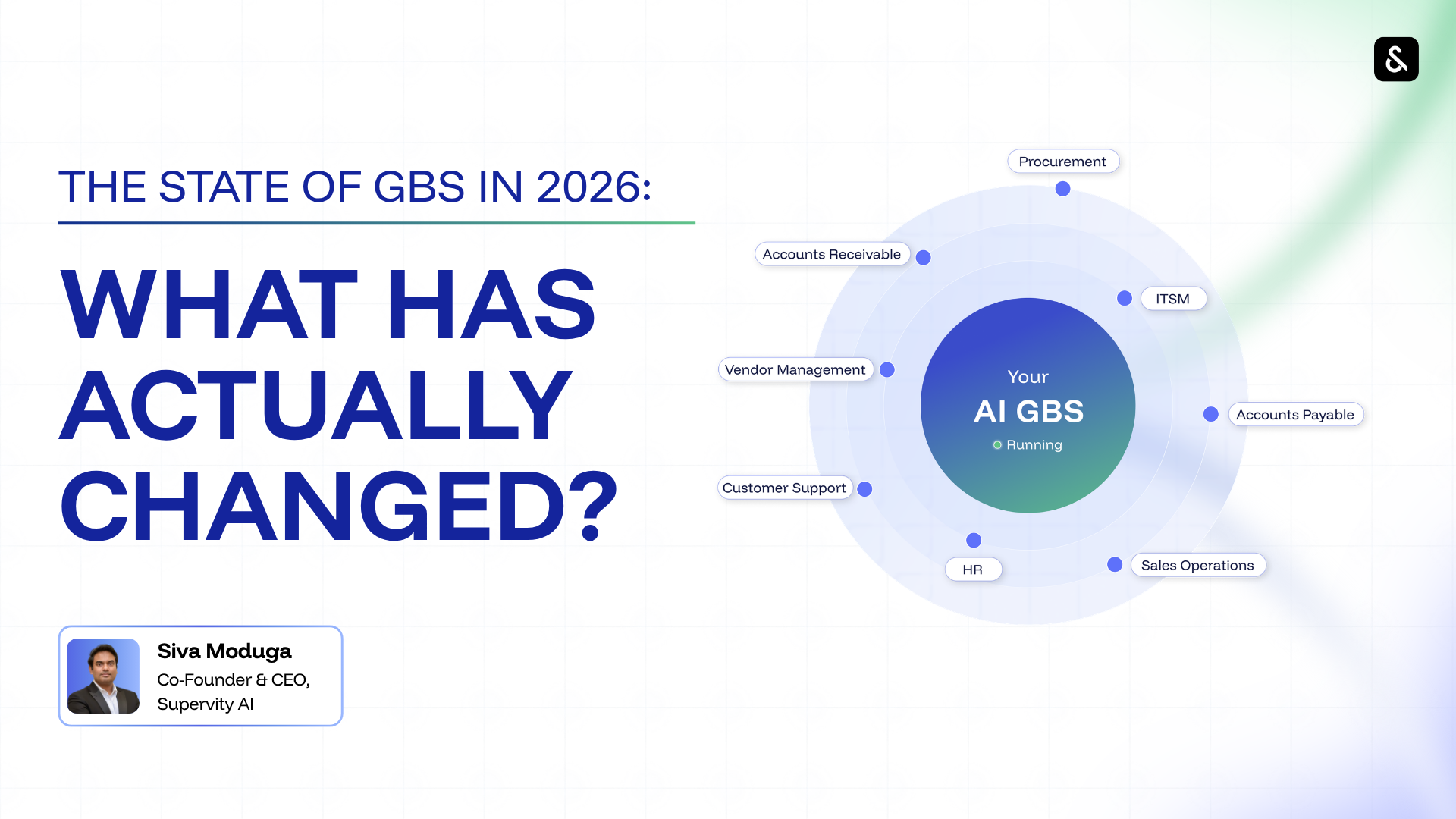
A great deal has changed in the AI conversation. Far less has changed in how work gets completed.
A year ago, the GBS conversation was full of predictions.
AI would transform service delivery. Productivity would rise. Teams would move beyond transactional work. Shared Services would become more strategic.
Those predictions were not necessarily wrong.
But as we move through 2026, I find myself asking a more practical question:
What has actually changed inside the operation?
AI is certainly more visible. Enterprises are testing it across Finance, HR, Procurement, IT and Customer Operations. It is now part of serious conversations about how GBS should operate.
But access to AI is not the same as operational change.
That happens when AI becomes part of how work moves, decisions are governed and services reach an outcome.
By that measure, GBS is still early in the transformation.
AI is no longer limited to innovation teams.
The McKinsey State of AI 2025 found that 88% of surveyed organizations were using AI in at least one business function. Yet only around one-third had begun scaling it across their organizations.
GBS teams now have more pilots and proofs of concept than they did a year ago. What many do not yet have is a corresponding change in how complete services operate.
AI may summarize a case, classify a ticket or extract information from an invoice.
But the case still needs resolution. The ticket still needs action. The invoice still has to move through matching, exceptions, approvals and payment.
An activity becomes faster. The service around it may remain the same.
The first phase of enterprise AI was dominated by one question:
What can the technology do?
In 2026, the better question is:
What result did it produce?
The IBM 2025 CEO Study found that only 25% of AI initiatives had delivered their expected return, while just 16% had scaled across the enterprise.
The problem is not a lack of ambition or investment.
Too often, AI has been added as another layer of technology without changing the underlying work.
A successful demonstration can still leave the organization with another interface to navigate and another output someone must carry into the next stage.
That is why leaders are becoming more disciplined about measurement.
Did the service become faster? Did more work reach completion? Did straight-through processing, cost to serve or service quality improve?
The metric is shifting from what the AI produced to what the service completed.
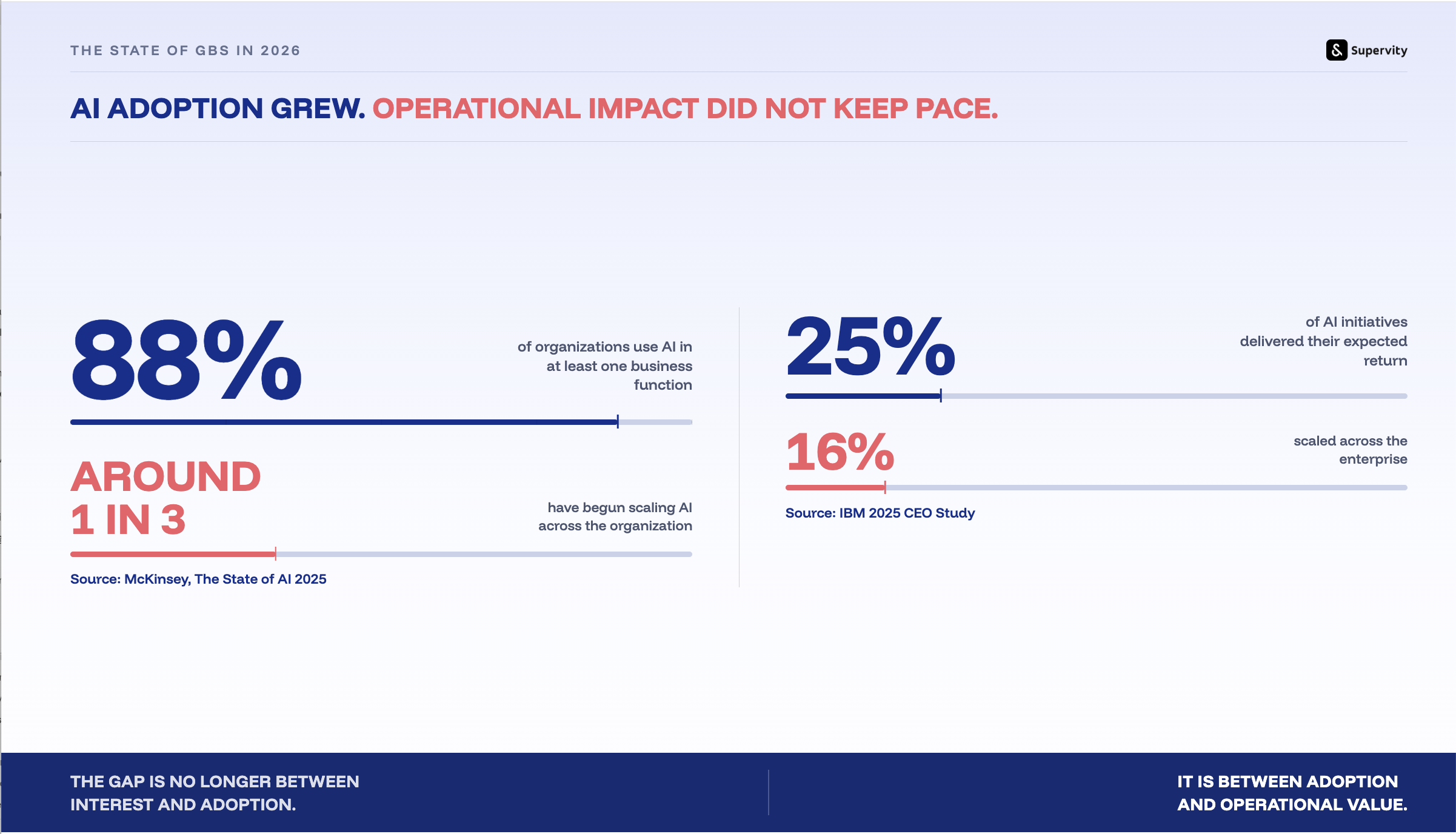
AI adoption has accelerated, but enterprise scaling and operational value have not kept pace.
For the last few years, many enterprise AI programs began by collecting use cases.
Every function produced a list. Every team identified tasks. The result was often a large pipeline of small opportunities.
That was a reasonable way to begin experimenting. It is not enough to transform GBS.
The stronger conversations I see today start with the service itself.
Leaders follow work from request to outcome and identify where context disappears, where exceptions return to an inbox and where a completed task still leaves the service unfinished.
This changes the unit of transformation.
Instead of asking how AI can improve one activity, leaders begin redesigning how the entire service moves and defining what people and AI should each contribute.
GBS is particularly well positioned to lead this shift. It already has process ownership, operating discipline, service measures and visibility across functions.
Those foundations can now support a more ambitious operating model.
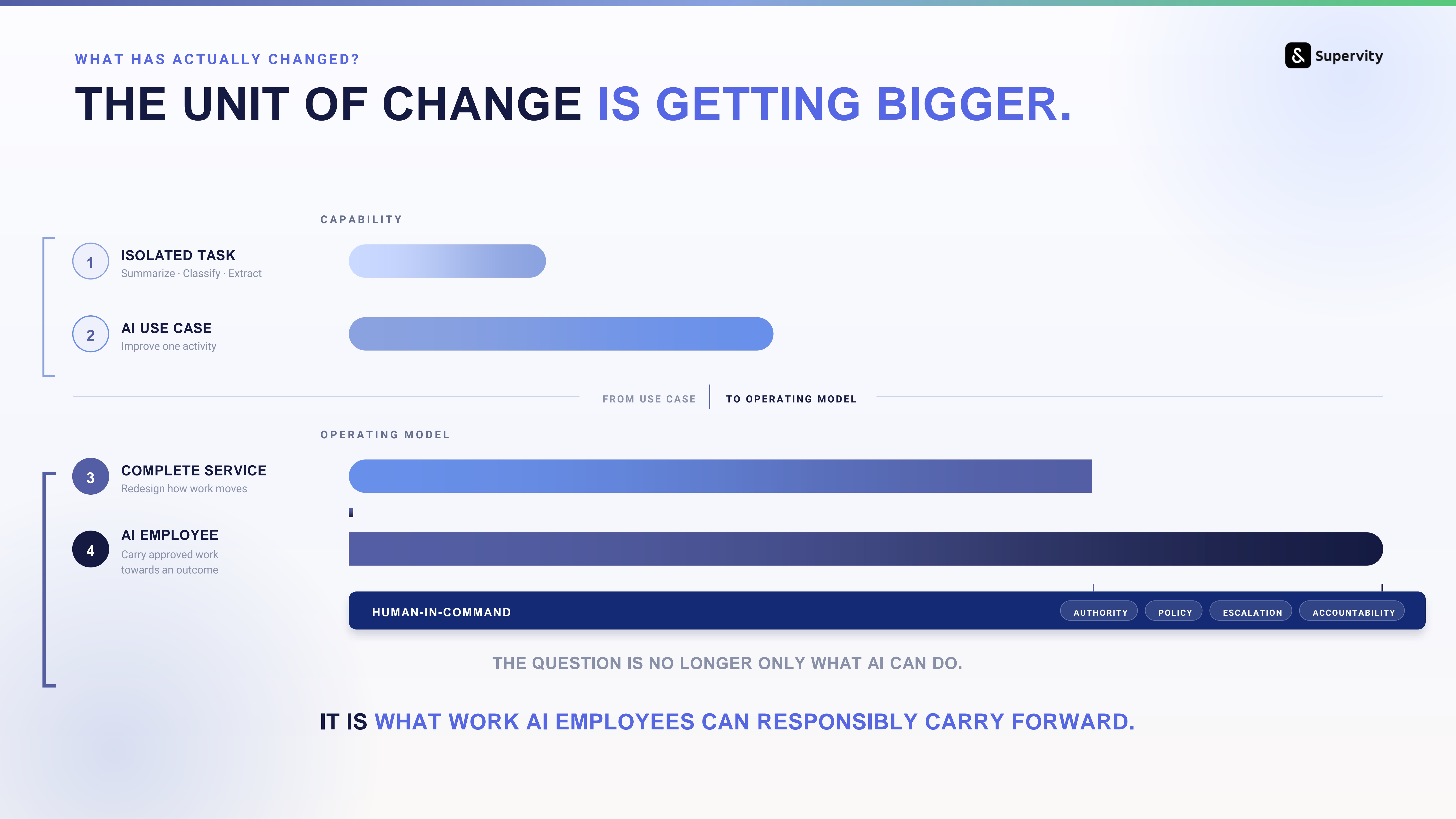
The unit of change is expanding—from improving one activity to giving AI Employees a defined role within the operating model.
A year ago, governance was often discussed after an AI use case had been selected.
Now it is becoming part of how the work is designed from the beginning.
As AI takes on more execution, authority, permissions, escalation paths and auditability must travel with the workflow. Governance cannot sit outside the operation as a policy document. It must shape what the technology can do, where it must stop and how people remain in control.
At Supervity, this is the principle behind Human-in-Command.
People establish the boundaries and retain accountability. AI Employees operate within that authority, progressing approved work and returning consequential decisions or genuine ambiguity to the right person.
This is also where the distinction between AI agents and AI Employees becomes important. AI agents generally describe software capable of reasoning or taking actions.
But enterprise work requires more than isolated agency. It requires a defined role, institutional context, operating boundaries and responsibility for moving work towards an outcome.
That is why we use the term AI Employees.
It describes not simply what the technology can do, but how it participates in the operation alongside people.
In my previous article, Have You Heard of the AI GBS?, I introduced AI GBS as the operating model we are helping leaders move towards.
In 2026, that shift is moving from an idea to an operating priority.
The next phase will not be led by the organization with the largest collection of AI pilots.
It will be led by the one that can define what its AI Employees are genuinely responsible for carrying to completion.




.webp)
