
.png)
Why the hardest work in Shared Services often begins after the automated step
A process can look automated on a dashboard and still depend on someone chasing it to completion.
I see this repeatedly in conversations with GBS leaders.
They can point to the tasks already handled by ERP platforms, workflow systems, RPA and, increasingly AI. But follow one request after information goes missing, a policy becomes unclear or two systems disagree, and a different picture emerges.
Someone finds the context. Someone explains the exception. Someone makes sure the next team knows what happened before the work reached them.
Over time, people have become the integration layer between enterprise systems. Most GBS leaders did not design it that way. It is simply what happens when each system performs its own role, but none maintains the full context across a service.
At Supervity, we are helping GBS leaders move towards AI GBS, an operating model where AI Employees work alongside their teams to keep services moving across systems, policies and process stages. People define their authority, contribute judgment where it matters and remain accountable for the outcome.
Consider employee onboarding.
Depending on the organization, a single request may move through HR Services, payroll, IT, identity management, workplace or procurement, and the hiring manager. Each team may have its own platform and automation. The service succeeds only when they work as one.
A missing approval delays equipment. Incorrect employee data holds up payroll. An unclear role affects system access. A location exception changes the policies that apply.
Nothing has necessarily broken. The request has simply left its expected path.
From there, someone must find the missing information, check the relevant systems and carry the request’s history into the next decision. These handoffs, not any single activity often determine whether onboarding takes hours or days.
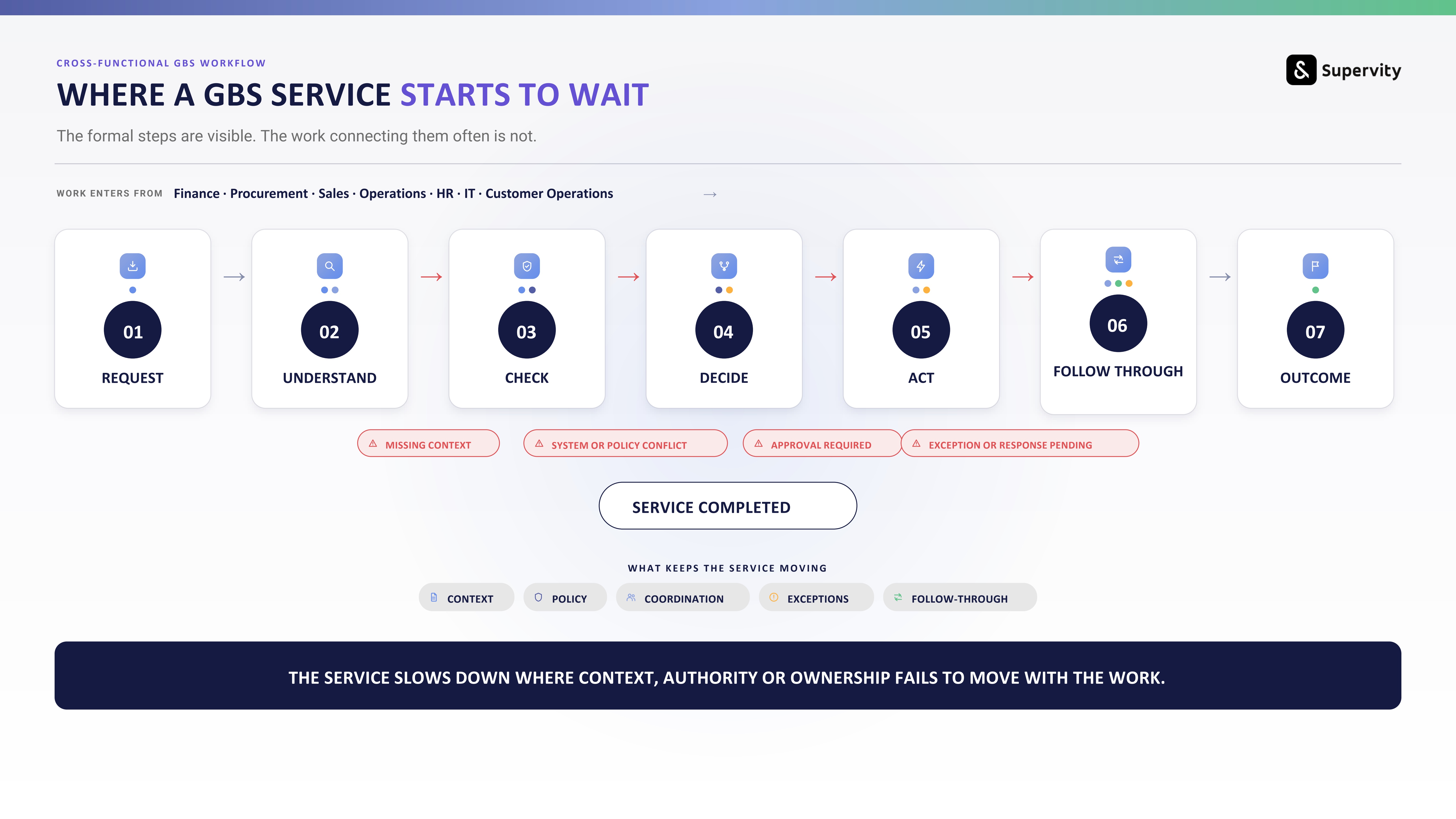
The workflow records the completed steps. It rarely captures the context, coordination, exceptions and follow-through required to connect them.
The same pattern appears elsewhere in GBS. A procurement request moves through policy checks, supplier communication and approvals. An IT request may need investigation and action after the ticket has been classified. An employee query may begin with a policy answer but conclude only after the permitted action has been completed.
.jpg.jpeg)
The formal steps are visible. The context, coordination and follow-through connecting them often are not.
The AI GBS Opportunity Map looks at two dimensions: how far work travels across teams and systems, and how much of the complete service it covers. Activities such as extraction, classification and search sit closer to task automation. As work requires more coordination, context and follow-through, the opportunity shifts towards connected execution and AI GBS. The map is illustrative rather than a maturity score; its purpose is to help leaders identify where AI Employees and people can improve an entire service together.
None of this diminishes what GBS and earlier generations of automation have achieved.
Centralization created common ownership. Standardization made processes repeatable. ERP and workflow platforms established reliable systems of record. RPA and APIs removed large volumes of manual activity.
They also created the structure needed for the next stage.
An AI Employee can work with less structured information, retain context across several steps and coordinate approved actions between systems. It can request missing information and prepare a genuine exception for the person authorized to decide it.
Once the decision is made, it can continue working with the team to complete the remaining steps. The person does not have to reconstruct the case or manually restart the process.
The same pattern appears elsewhere in GBS. A procurement request moves through policy checks, supplier communication and approvals. An IT request may need investigation and action after the ticket has been classified. An employee query may begin with a policy answer but conclude only after the permitted action has been completed.
AI GBS connects these stages so that the service can retain its context as it moves.
Every conversation about this eventually reaches control, and it should.
AI Employees need defined permissions, policy boundaries and escalation rules. Material exceptions must reach the right person with a reviewable record of what has happened. People must be able to intervene, override and remain accountable for the service.
We call this Human-in-Command.
It gives AI Employees room to execute within established boundaries while keeping people involved in policy, judgment and consequential decisions. The partnership is designed around what each contributes to the service.
The AI GBS opportunity grows as work moves from an individual activity towards a cross-functional, end-to-end service.
For GBS leaders, this means starting with a complete service rather than a catalogue of AI use cases.
Follow that service from request to completion. Look for the point where context disappears, someone must chase the next action, or a routine exception drops the work back into an inbox.
The dashboard tells you how much of the process is automated. The moments after an exception tell you how the operation works. AI GBS is built for those moments.




.webp)
