
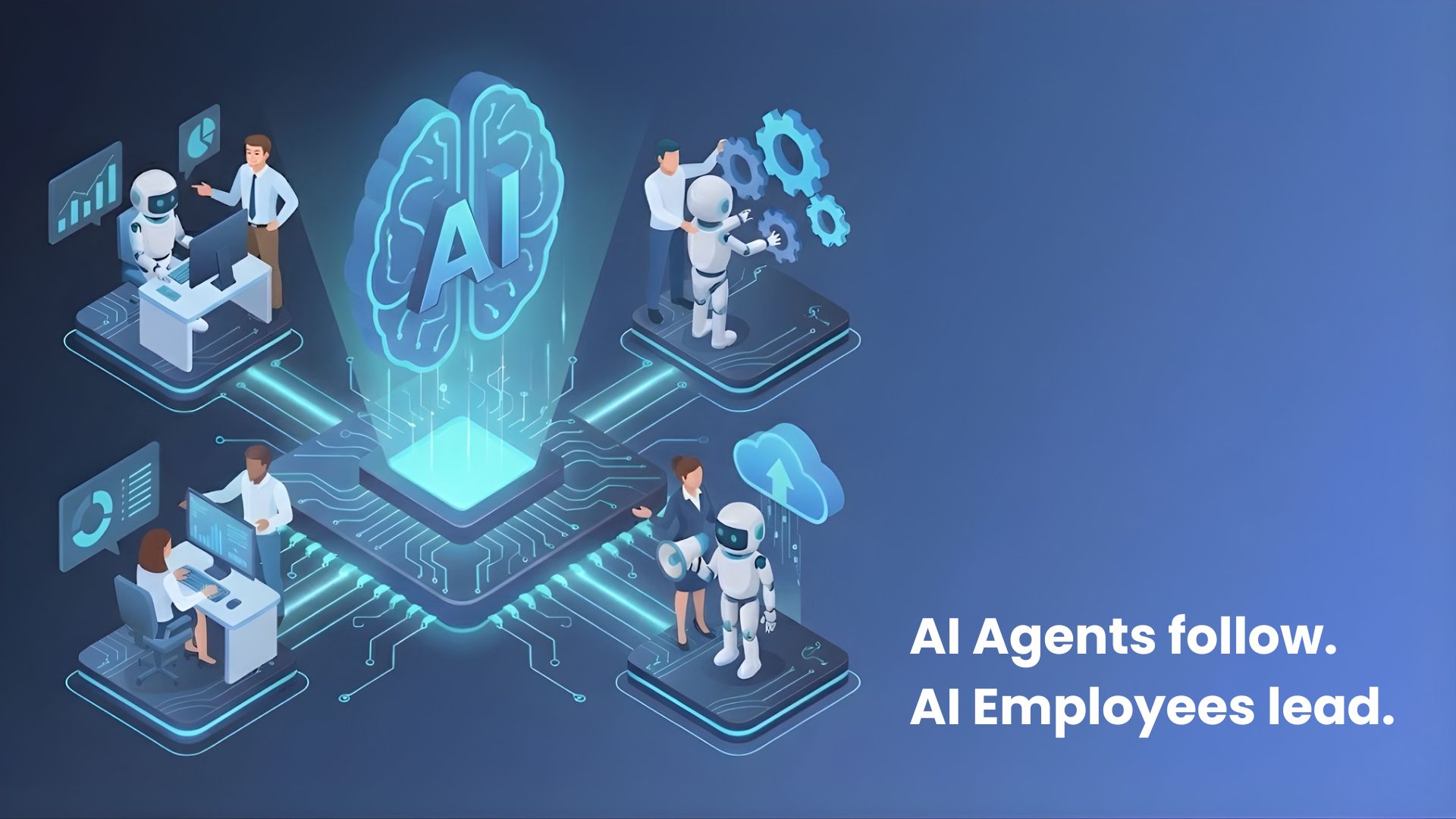
Most enterprises believe they’re already “using AI.” They’ve deployed a few chatbots, automated workflows, maybe even built internal AI Employees that complete isolated tasks.
But here’s the uncomfortable truth:
Most AI initiatives automate tasks. Only a few transform the business.
And the difference comes down to this:
AI Employees automate tasks. AI Employees run workflows, with precision, accountability, and the ability to learn.
AI Employees complete instructions.
AI Employees understand context, adapt to edge cases, and work within a Human-in-Command framework to produce outcomes, not just outputs.
This difference is why AI Employees have become essential, not optional for enterprises that want real digital transformation.
Traditional automation is linear: If X happens, perform Y.
AI Employees are different; they handle complex, multi-step decisions with the precision of a machine and the oversight structure of a human-led workforce.
AI Employees cross-reference data, reconcile inconsistencies, and maintain a full reasoning trail. Where humans fatigue, AI Employees maintain accuracy at scale.
AI Employees complete a task.
AI Employees understand the entire workflow, managing exceptions, communicating with systems, and escalating intelligently.
This is the difference between replying to an email… and running an entire Accounts Payable cycle.
AI Employees plug into finance, procurement, HR, customer support, operations, the same way a new hire would. They work with existing ERPs, CRMs, data hubs, and internal teams.
And importantly: They don’t disrupt the workflow. They become part of it.
AI Employees learn from corrections and evolve through lifecycle governance. That means they become more accurate, more contextual, and more aligned with business rules over time, something no static automation tool can do.
Digital transformation has outgrown automation. It requires intelligence, adaptability, and operational scale, exactly what AI Employees are designed for.
Enterprises rarely fail because they lack tools; they fail because they cannot scale precision. AI Employees handle increased workloads without additional headcounts, fatigue, or inconsistency.
AI Employees clear backlogs, stabilize workflows, and reduce error rates across departments, often within weeks of deployment.
Automation stays static.
AI Employees evolve continuously and improve with every exception handled.
This creates something genuinely new:
A workforce that increases your organization’s intelligence, not just its speed.
Many companies believe they can “wait and see.” But digital transformation has already shifted
The businesses that thrive will be those that:
If your organization still relies on traditional automation while your competitors deploy AI Employees, the performance gap will widen, permanently.
Automation was Phase 1.
AI Employees are Phase 2, and they are defining the winners.
Despite their capabilities, AI Employees are not here to replace humans. They exist to remove the operational weight that prevents people from doing meaningful work.
Humans excel at:
AI Employees excel at:
The combination creates a hybrid workforce that is exponentially more capable than either humans or AI alone.
Digital transformation is no longer about swapping old tools for new ones. It’s about redesigning how work happens.
With a Human-in-Command model, AI Employees bring operational intelligence while human teams drive strategy, ethics, and oversight.
This is the real future of the enterprise workforce — one where humans lead, AI Employees execute, and organizations scale with confidence.
Ready to see how AI Employees can transform your operations?
Book a demo: https://www.supervity.ai/request-a-demo
Experience how Human-in-Command AI Employees help organizations scale with precision, accuracy, and reliability.




.webp)
