
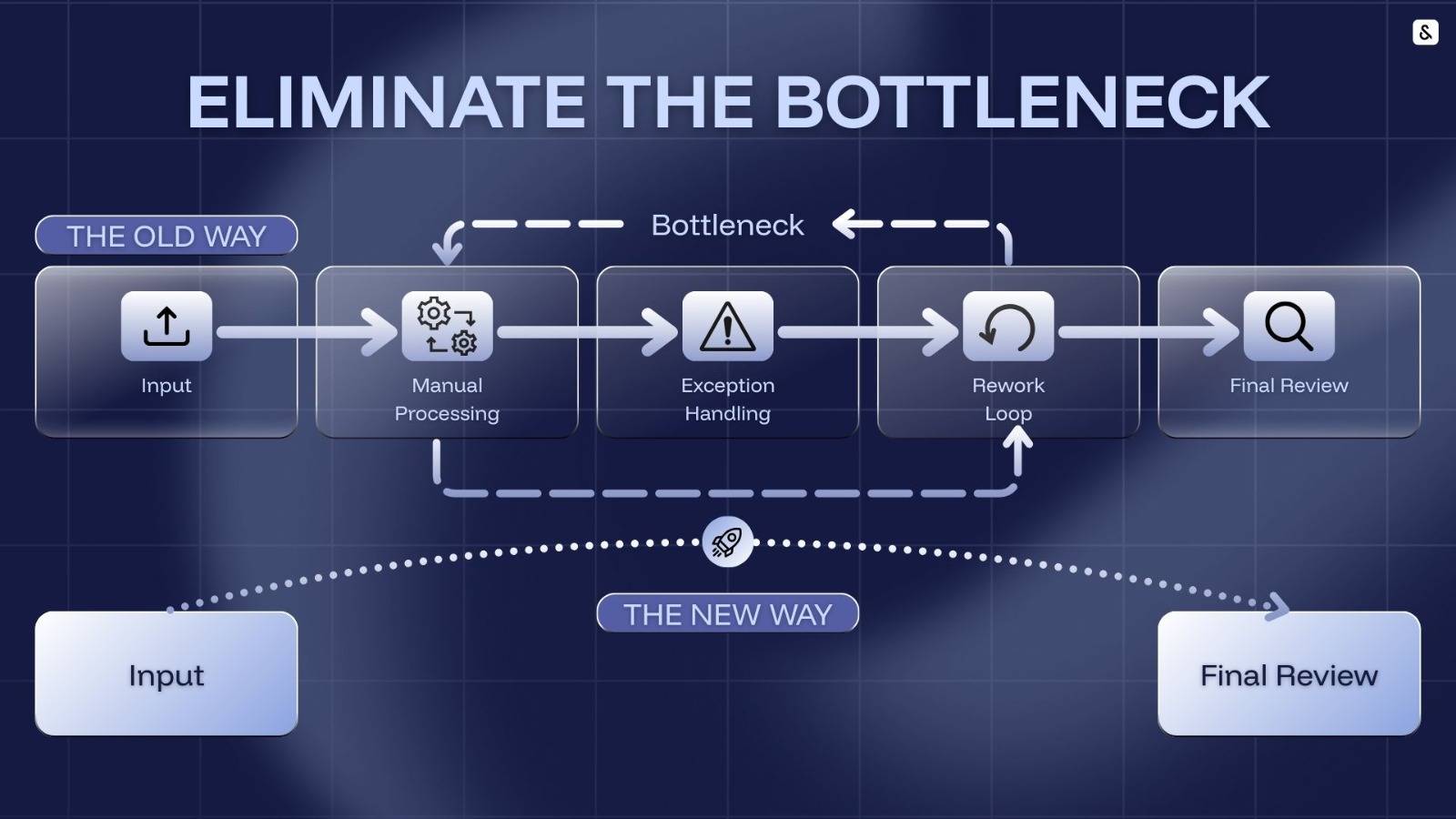
For decades, enterprises have relied on outsourcing as the default answer to scale operations.
The logic was straightforward: move work to lower-cost geographies, add people as volumes grow, and manage performance through SLAs. For a long time, this model worked well enough.
Today, it no longer does.
Outsourcing has become expensive, fragile, and increasingly misaligned with how modern enterprises need to operate. Costs continue to rise, productivity gains have flattened, compliance risk has increased, and service quality remains inconsistent. Yet most organizations continue to tolerate these shortcomings because they believe there is no viable alternative.
AI-Shoring changes that assumption.
Outsourcing is fundamentally a people-scaling model.
As volumes increase, more headcount is added. As complexity grows, additional layers of management and governance appear. Over time, this creates a system where:
Even well-run BPO relationships eventually hit a ceiling. The model optimizes labor arbitrage, not operational intelligence.
AI-Shoring replaces the people-scaling model with a software-scaling model.
Instead of outsourcing work to human teams, enterprises deploy AI Employees to execute operational tasks directly within workflows. These AI Employees operate continuously, follow policy by design, and improve through usage rather than tenure.
The result is a fundamentally different operating dynamic:
AI-Shoring is not about automating isolated tasks. It is about replacing the outsourcing construct itself.
Traditional automation initiatives often struggle to show fast returns because they:
AI-Shoring works differently.
By deploying AI Employees directly into existing operational workflows, enterprises can:
This is why AI-Shoring consistently delivers:
These gains come from execution efficiency, not workforce compression alone.
One of the most important shifts AI-Shoring introduces is economic.
Outsourcing converts operational demand into recurring labor expense. AI-Shoring converts that same demand into software-like economics:
For CFOs and COOs, this represents a structural improvement, not a short-term cost play.
AI-Shoring is the first engine of AI-First Operations.
It delivers immediate, provable value by replacing outsourcing across functions such as:
Importantly, AI-Shoring also lays the foundation for what comes next. Every workflow executed by AI Employees generates learning — exceptions handled, policies enforced, outcomes tracked.
This learning compounds.
Many enterprises attempt to modernize outsourcing through:
These approaches optimize a model that is already structurally constrained.
AI-Shoring does not improve outsourcing.
It renders it unnecessary.
Just as cloud computing replaced physical infrastructure rather than optimizing it, AI-Shoring replaces labor-centric delivery with intelligence-centric execution.
AI-Shoring solves the most urgent enterprise problem: rising operational cost with limited productivity gains.
But it also does something more important – it creates the conditions for Self-Operating Enterprise Apps.
As AI Employees execute more work and learning accumulates, enterprises can move beyond cost reduction toward autonomous operations governed through AI Command Centers.
That is the second engine of AI-First Operations.




.webp)
