
Every finance leader today knows automation has transformed Accounts Payable (AP), invoices are scanned, workflows are digitized, and payments are processed in record time.
Yet, at every quarter close, the same questions keep surfacing: Why did exceptions spike? Where are approvals getting delayed? Why does reporting still lag behind reality?
Because most AP automation to date was built for motion, not understanding. Systems execute. They don’t explain. They process transactions but rarely learn from them. And that’s where finance will stand in 2026, with efficient systems that move faster but not necessarily think smarter.
To understand how we got here and where we’re going next, it helps to look at the maturity curve of AP automation.
Across hundreds of finance teams, four broad stages of automation have emerged:
Each stage brought value. Each solved a pain point. But none addressed the whole. Because automation has remained fragmented by function, not unified by intelligence.
Let’s look at the leading players shaping these stages, and where the next frontier begins.
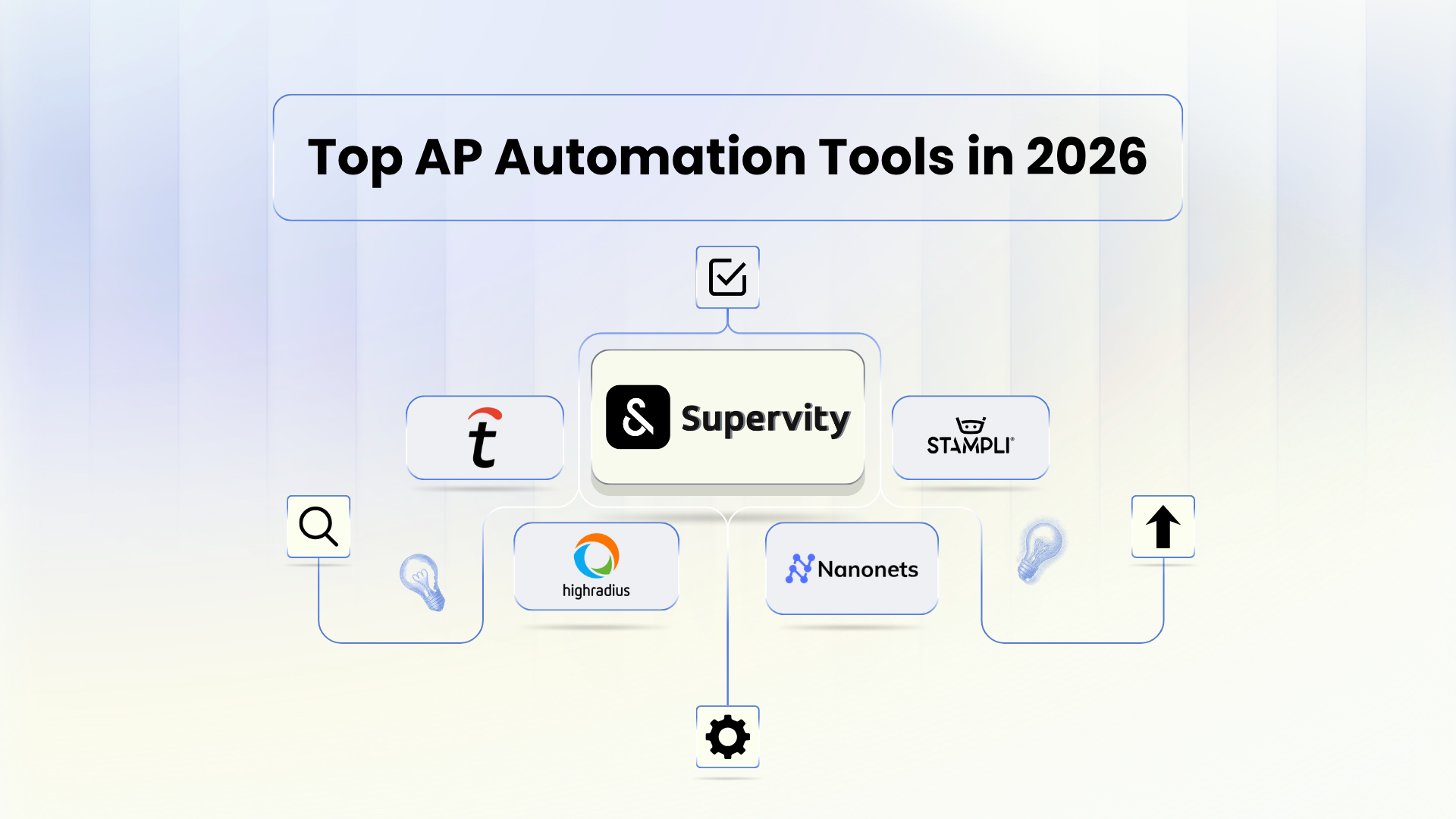
Nanonets made it easy for finance teams to digitize invoices quickly. Its strength lies in document capture and extraction, giving teams a faster start to data entry and validation.
It’s ideal for smaller teams beginning their automation journey: though it stops short of reasoning, compliance, or analytics.
Best for: SMBs taking their first step into automation.
Limitation: Visibility ends once the data is captured.
Stampli took a people-first approach, making invoice approvals conversational. Its interface centralizes feedback and accountability, reducing delays and confusion.
It shines where human collaboration drives process success, though it leaves deeper data intelligence and governance for other tools to fill.
Best for: Mid-sized organizations seeking transparency.
Limitation: Limited analytical depth and scalability.
Tipalti became known for control and regulatory discipline. It enforces structure across entities and geographies, ensuring clean books and predictable reporting.
Its rigor is unmatched, but it focuses on governance, not adaptive learning.
Best for: Enterprises prioritizing compliance and standardization.
Limitation: Excellent for stability, less so for dynamic intelligence.
HighRadius unifies payables and receivables within structured enterprise frameworks. Its integrations are deep, making it a reliable choice for complex, multi-system environments.
However, the trade-off is flexibility, it’s built for consistency, not continuous evolution.
Best for: Large enterprises needing unified control.
Limitation: Heavy configuration and slower adaptability.
Each of these solutions plays a vital role, one digitizes, another collaborates, one governs, another integrates.
Yet, finance teams today often find themselves managing a network of good tools that don’t talk to each other.
Data flows, but intelligence doesn’t.
Dashboards show what happened, but not why.
Workflows move faster, but insight arrives later.
That’s the limitation of automation when it stops at execution.
And that’s where a new idea is taking hold, the AI Employee.
Imagine an AP system that not only executes but also thinks, reasons, and learns, one that explains its decisions, flags anomalies before they occur, and adapts to new business logic without human intervention.
That’s what defines an AI Employee. It’s not software you run. It’s a digital teammate that collaborates, audits, and improves with every transaction.
At Supervity, we’ve seen this shift firsthand. The AP AI Employee was built not to replace humans, but to work alongside them, interpreting data, orchestrating workflows, and ensuring every action is explainable and compliant.
It bridges operational, collaborative, and governance intelligence into one unified system, closing the loop between insight and action.
“The goal was never to automate finance, it was to give finance leaders clarity, control, and confidence to steer with intelligence.”
Automation solved what.
AI Employees solve the why and the how.
They don’t just process invoices; they understand them.
They don’t just reconcile data; they reason through exceptions.
They don’t just move faster; they move smarter, adapting to every transaction and context.
This is where the finance function evolves from running processes to running intelligence.
The next era of AP transformation won’t be about choosing yet another tool, it’ll be about choosing a teammate that learns, reasons, and ensures every number adds up with confidence.
The future of finance belongs to AI Employees, systems that don’t just automate work but understand it.




.webp)
