Enterprises today are facing two problems at the same time.
The first is immediate and operational: outsourcing costs continue to rise, service quality remains inconsistent, talent dependency is increasing, and compliance and geopolitical risks are becoming harder to ignore.
The second problem is structural: enterprise software was never designed to operate autonomously. Even after decades of digitization, most work is still executed manually - coordinated through people, emails, spreadsheets, and approvals layered on top of static systems.
Solving just one of these problems is no longer enough. Enterprises need measurable savings today and a fundamentally new operating model for tomorrow.
This is where AI-First Operations emerge, not as a collection of AI tools, but as a dual-engine operating model: one engine focused on replacing outsourcing with AI-Shoring, and another focused on building Self-Operating Enterprise Apps through AI Command Centers and AI Employees.
AI-First Operations represent a shift in how work is designed, executed, and governed.
In traditional models, software supports people. In AI-First Operations, AI becomes an active operational participant, executing work alongside humans under defined oversight.
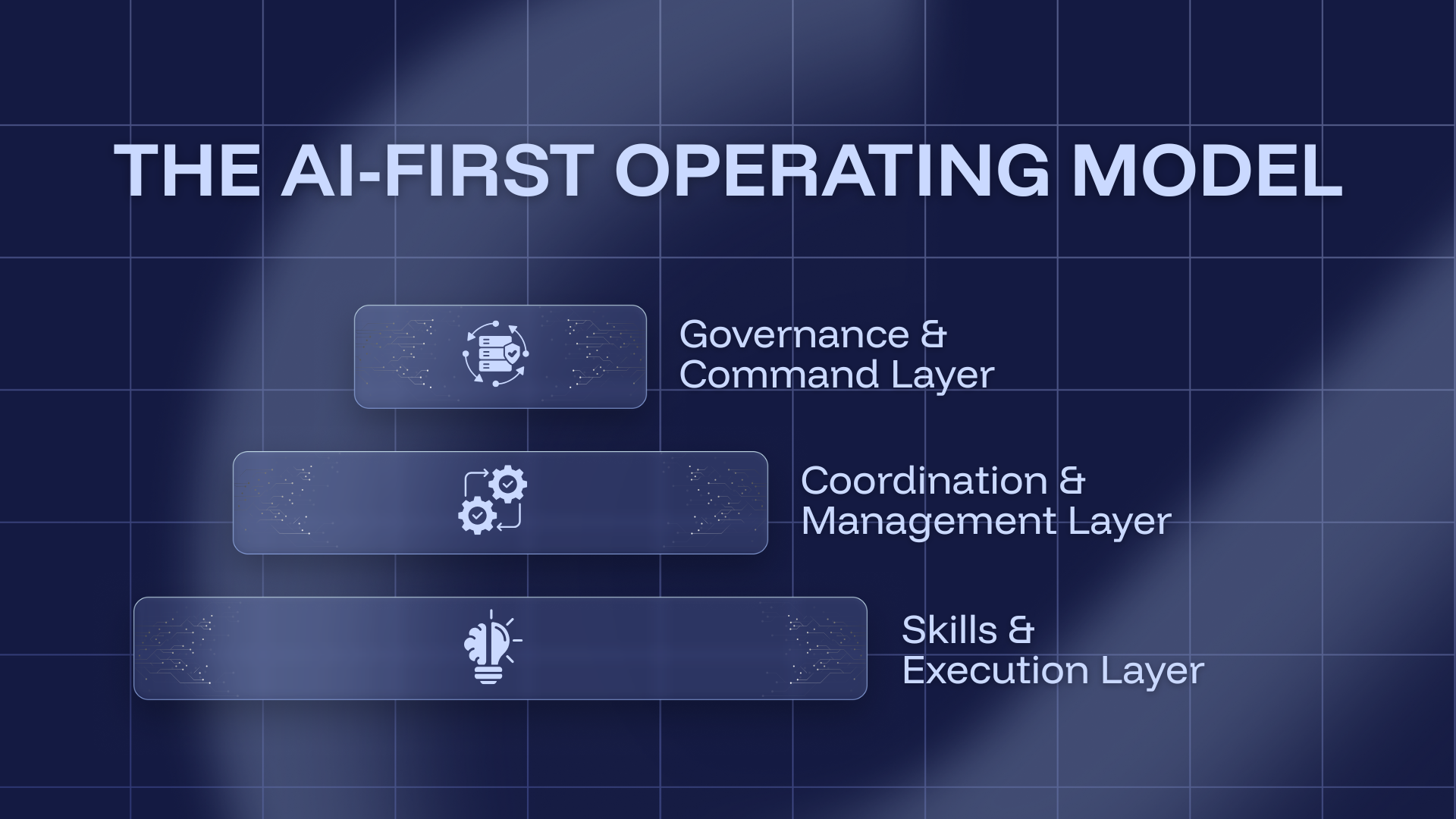
This model is built on three core constructs:
Together, these constructs move enterprises from task automation to self-operating workflows, with memory, auditability, and outcome ownership built in.
Most enterprises still operate through a mix of:
This model scales headcount, not intelligence. Productivity gains plateau, costs compound, and institutional knowledge remains trapped in people rather than systems.
AI-First Operations address this by redesigning the system itself, not by adding more layers on top of it.
The first engine of AI-First Operations is AI-Shoring.
AI-Shoring replaces traditional outsourcing with AI Employees executing operational work at software speed and scale. It delivers:
For enterprises, this creates immediate, provable value, often within weeks. AI-Shoring is not a future promise; it is a present-day operating advantage.
While AI-Shoring delivers immediate savings, the second engine defines the future.
Self-Operating Enterprise Apps are applications that don’t just record transactions, but run workflows autonomously, handling execution, exceptions, and learning within defined boundaries.
At the center of this model sits the AI Command Center.
Unlike dashboards that only show information, AI Command Centers:
This transforms enterprise software from passive systems into active operational platforms.
AI-First Operations require new measures of success.
Instead of focusing solely on activity or headcount, enterprises begin to track:
The AI Command Center becomes the single source of truth for these outcomes.
As AI-First Operations mature, organizations begin to see the emergence of AI-enabled departments: finance, IT, HR, and operations functions where AI Employees handle the majority of transactional work under human supervision.
Humans remain accountable. AI executes. Command Centers coordinate.
This is not about replacing people. It is about changing what people spend their time on.
AI-First Operations are not a single product shift. They represent a new enterprise operating model powered by two engines:
The shift from automating tasks to building autonomous operations represents a fundamental change in how enterprises will compete and scale. Leaders who understand this transition won't just be adopting new tools; they will be redefining the way work gets done.
See the future of AI-First Operations in action.: https://www.supervity.ai/request-a-demo




.webp)