
Enterprise software was never designed to operate.
It was designed to record.
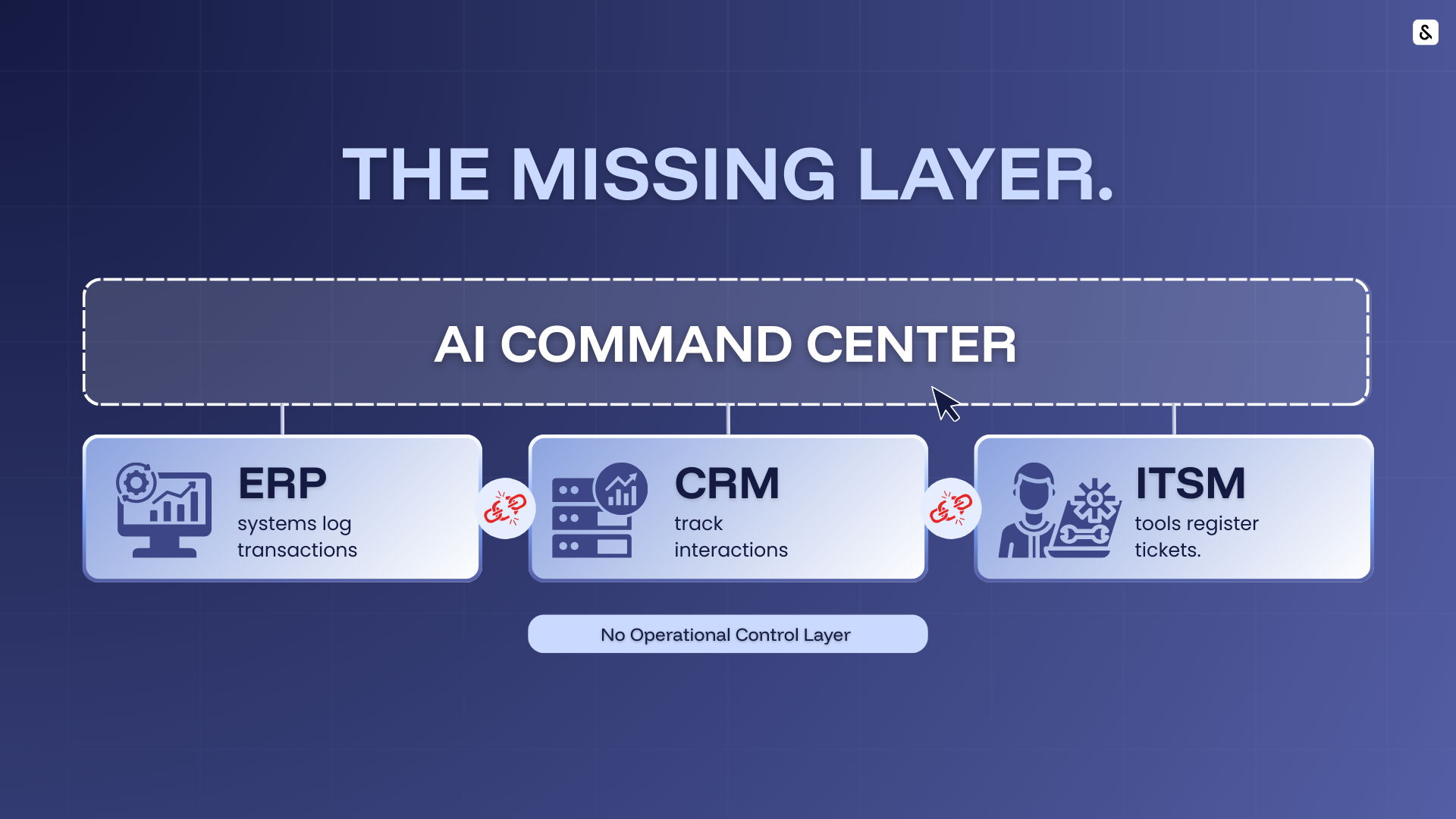
ERP systems log transactions.
CRMs track interactions.
ITSM tools register tickets.
Dashboards display status.
But none of these systems decide what should happen next. That responsibility still sits with people, coordinating work through emails, meetings, escalations, and judgment calls layered on top of static applications.
This is the central contradiction of modern enterprises:
we have sophisticated systems, yet operations remain human-run.
Most organizations assume that if they have enough applications and dashboards, operations should “run better.”
They don’t, because visibility is not control.
Dashboards answer:
They do not answer:
As a result, enterprises operate through a fragile layer of human coordination that software never absorbed.
Automation helped, but only partially.
Traditional automation executes predefined steps. When conditions are stable, it works well. When exceptions appear and they always do, work reverts to people.
This creates a familiar pattern:
The system itself never becomes operationally intelligent.
What enterprise software lacks is not intelligence, it is control.
Modern operations require a layer that can:
Traditional enterprise stacks don’t have this layer.
That is why operations remain human run even in highly digitized environments.
An AI Command Center is not a dashboard.
It is not a reporting layer.
It is not another application.
It is the operational control layer that enterprise software has been missing.
AI Command Centers:
In effect, the AI Command Center becomes the place where work is directed, not just observed.
When AI Command Centers sit above enterprise applications, the role of software changes.
Applications stop being passive systems of record and become participants in execution.
Workflows no longer depend on:
Instead:
This is what enables Self-Operating Enterprise Apps.
Adding AI features to applications does not make them self-operating.
What matters is where decisions live.
If decisions remain distributed across people, inboxes, and meetings, operations remain human-run, regardless of how advanced the tools are.
AI Command Centers centralize operational decision-making while preserving human oversight. That is the difference.
One of the most important distinctions AI Command Centers introduce is governance.
Humans are not removed. They are repositioned.
Instead of:
Humans:
This is how autonomy scales without losing trust.
Organizations that continue to rely on dashboards and task-level automation will see incremental gains, and then plateau.
Without an operational control layer:
AI Command Centers solve this at the system level.
The move from human-run operations to self-operating systems will not happen through one tool or one project.
It will happen when enterprises accept a simple truth:
Software cannot run operations unless it is allowed to decide.
AI Command Centers are how that decision-making enters the enterprise stack — with humans firmly in command.




.webp)
