
Enterprise software has improved dramatically over the last two decades.
It captures more data.
It connects more systems.
It gives better visibility than ever before.
And yet, one thing hasn’t changed: It still doesn’t run the work.
People do.
People chase approvals.
People decide what happens next.
People fix what breaks.
Most enterprise software doesn’t operate anything.
It simply documents work after the fact.
That model is now breaking.
Enterprise applications were built to:
That’s useful. But let’s be clear:
Recording work is not the same as running it.
Execution still depends on:
In other words:
The system holds the data. The operation lives outside it.
That’s the flaw.
A self-operating enterprise app doesn’t just support work.
It owns the execution of work, within defined boundaries, while keeping humans in command.
If an application still depends on people to constantly push work forward, it is not self-operating.
It is assisted at best.
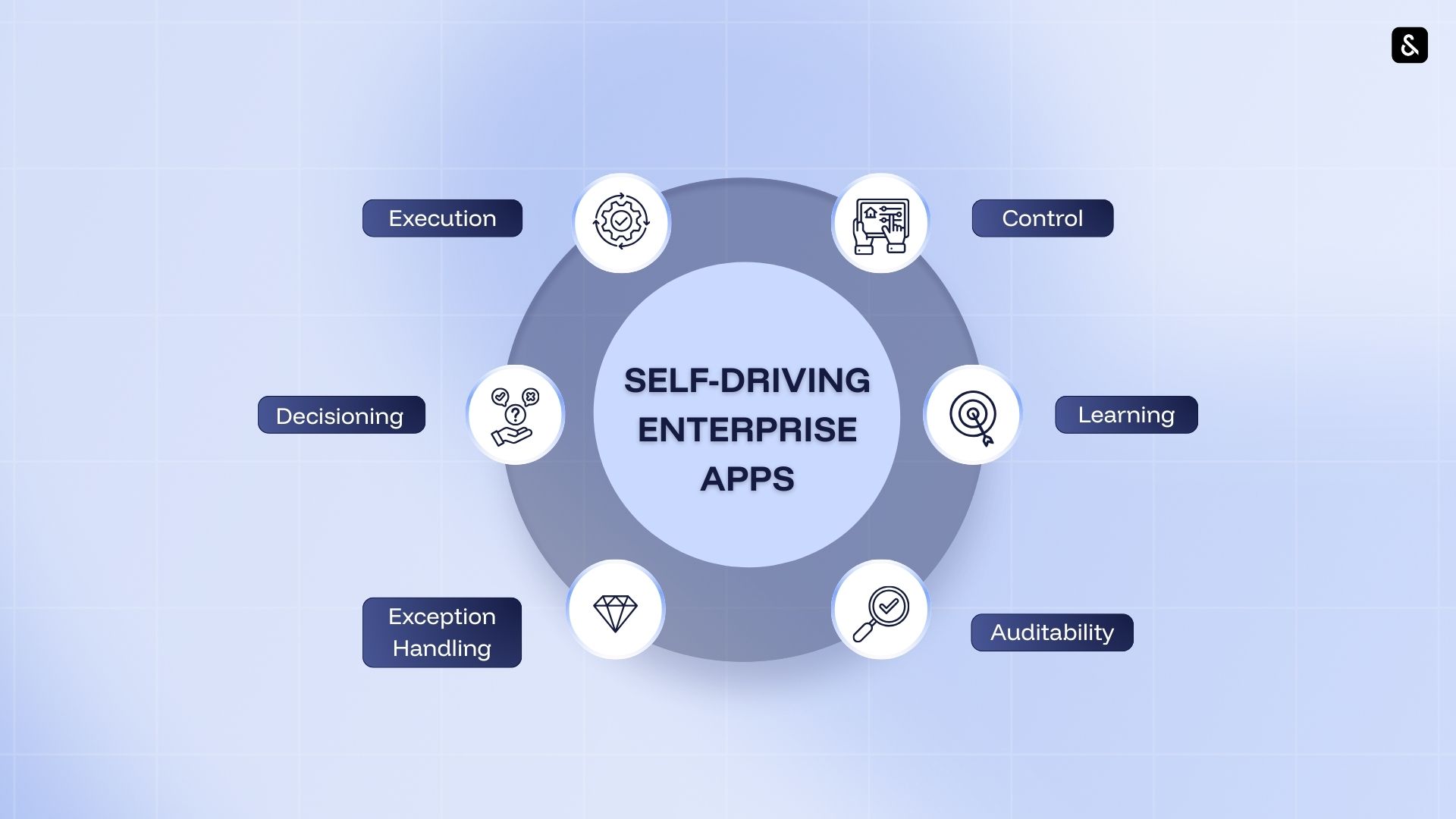
For software to truly operate, six capabilities must exist inside the system itself.
Triggering tasks is not execution.
Updating status is not execution.
Self-operating systems:
End-to-end.
If your workflow needs people to move it forward, your system isn’t executing it.
Work requires decisions. Most systems avoid them.
They push decisions back to humans disguised as approvals, reviews, or escalations.
Self-operating systems don’t avoid decisions. They:
Within defined boundaries.
If every decision still sits with a person, the system isn’t operating — it’s waiting.
Real operations are messy. Exceptions are constant.
In traditional systems, exceptions break the flow. Work stalls. People step in.
Self-operating systems:
A system that breaks under exceptions isn’t a system. It’s a dependency.
Dashboards show what’s happening.
They don’t control anything.
Self-operating systems require a control layer that:
This is the difference between visibility and control.
If your system only tells you what happened, it isn’t running operations.
Most enterprise software is static.
It repeats the same logic, regardless of outcomes.
Self-operating systems improve:
If your system doesn’t learn, your operations don’t improve. They just repeat.
Autonomy without trust doesn’t scale.
Self-operating systems ensure:
Not as an afterthought but as a design principle.
If you can’t explain what the system did, you won’t trust it to run anything.
Adding AI features doesn’t make software self-operating.
Adding automation doesn’t either.
The real question is simple:
Who is responsible for running the work - the system or the people?
In traditional enterprise software:
In self-operating systems:
That is a fundamental shift.
Today:
In self-operating systems:
The goal is not to remove humans from the system. It is to remove them from routine execution.
As operations scale, this becomes unavoidable.
Systems that cannot:
will continue to depend on human coordination and fall behind systems that don’t.
There is one test that matters:
If the system cannot run the workflow without constant human coordination, it is not self-operating.
Enterprise applications are no longer evolving to be smarter.
They are evolving to operate.
And once that shift begins, there is no going back.
At Supervity, we work with enterprises that are beginning this shift, moving from systems that record work to systems that operate it. The transition is still early, but the direction is clear.




.webp)
