
I’ve spent years watching GBS evolve with automation at its core.
But somewhere along the way, we traded one kind of complexity for another.
We brought in automation to reduce effort.
Instead, many teams today are managing bots, stitching workflows, and resolving exceptions at scale.
At some point, you realize—this model has a ceiling.
In my experience, most automation tools are built around tasks.
But enterprise operations don’t run on tasks, they run on end-to-end execution.
And that gap shows up quickly:
What begins as efficiency often turns into operational drag.
Over the past year, working closely with GBS leaders, I’ve seen a clear shift.
This isn’t about improving automation.
It’s about moving beyond it.
Self-driving enterprise apps don’t sit on top of processes.
They run them.
AI Employees execute workflows end-to-end, across Finance, Procurement, HR, IT, handling not just tasks, but decisions, context, and coordination.
When execution moves to software, the role of GBS changes fundamentally.
I’m seeing teams move away from:
And toward:
This is what I call the Human-in-Command model: where humans define intent, and systems carry it through.
In production environments, the shift is already visible:
These aren’t incremental improvements.
They signal a structural shift in how operations run.
For a long time, GBS has been measured on efficiency.
I don’t think that’s enough anymore.
The real question is:
How much value can GBS generate for the enterprise?
That requires rethinking the architecture, not just optimizing the existing model.
Most organizations are still trying to get more out of the current stack.
But the ones pulling ahead are doing something different:
And once that shift happens, it compounds.
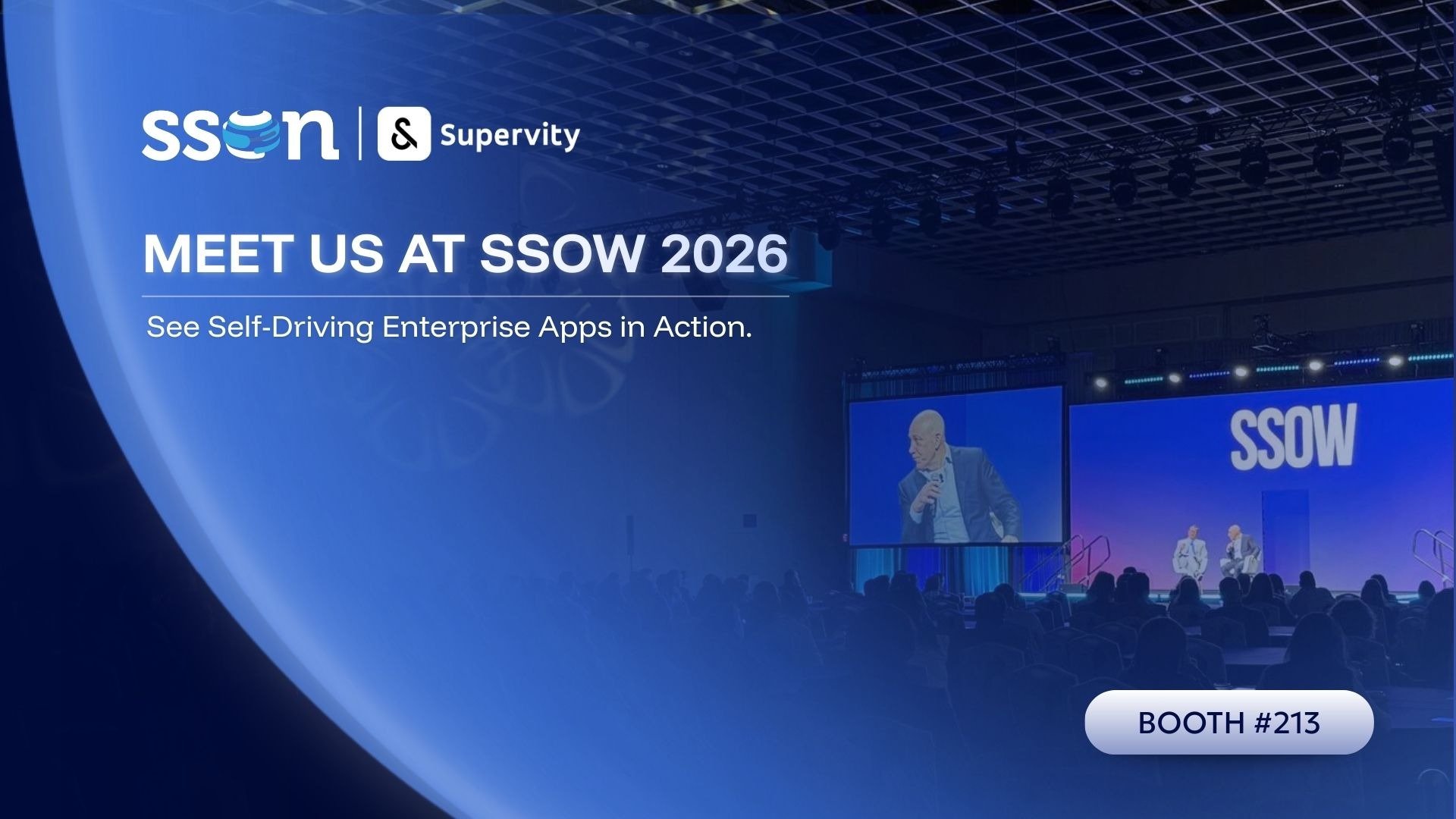
I’ll be at SSOW 2026 in Orlando, and I’m looking forward to engaging with leaders who are thinking about this shift.
Booth #213
We’ll be showcasing live self-driving enterprise apps across Finance, HR, Procurement, IT, and Support.
Client Session | March 18
I’ll be joined by Sudesh Jain and Madhavi Isanaka from the Adani Group. We’ll walk through a practical blueprint for building a self-driving GBS at enterprise scale.
GBS Select & After-Hours
Smaller, candid conversations on what this shift looks like in practice.
If you’re at SSOW, I’d value the conversation.
Let’s talk about what it takes to move beyond automation, and build a GBS that drives itself.
Co-Founder & CEO, Supervity




.webp)
