
Most conversations about AI in operations focus on productivity.
Very few focus on economics.
That’s a mistake.
What makes AI-Shoring fundamentally disruptive is not that it automates work fast, it’s that it changes the underlying cost structure of enterprise operations. Once that happens, traditional outsourcing and labor-centric delivery models become economically uncompetitive.
In outsourcing-led operations, cost behaves in a predictable way:
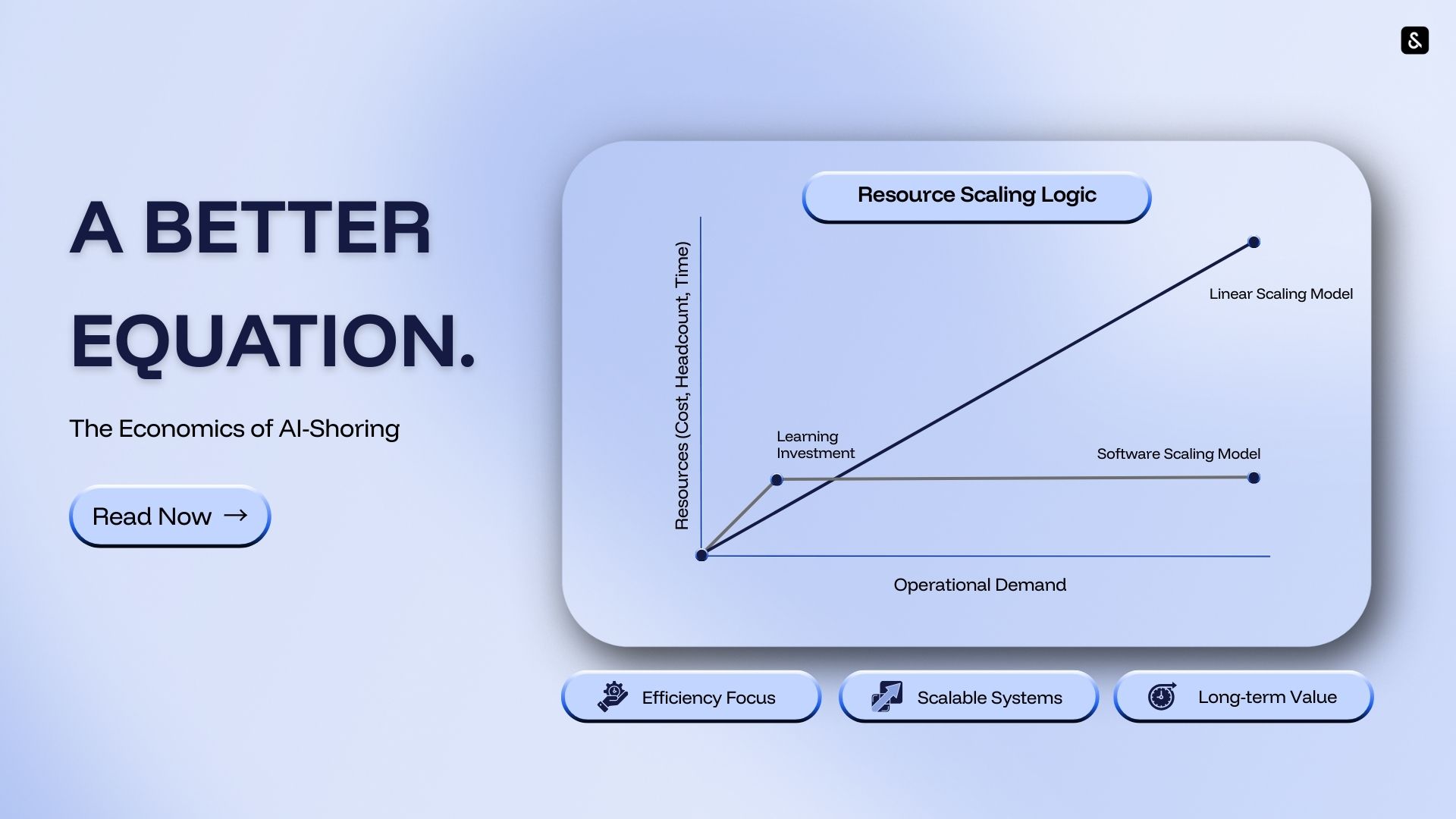
Even with process improvements, the core equation remains unchanged. Labor scales linearly with demand. Productivity improvements are incremental, and savings plateau quickly.
AI-Shoring replaces the labor-scaling model with a software-scaling model.
Instead of hiring, training, and managing people to absorb demand, enterprises deploy AI Employees that execute operational work directly within workflows.
This introduces a fundamentally different set of economic characteristics:
In other words, AI-Shoring behaves economically like software, not services.
One of the most counterintuitive aspects of AI-Shoring is that savings compound.
In labor-based models:
In AI-Shoring:
This is why enterprises often see:
Not because work disappears, but because execution becomes structurally more efficient over time.
Outsourcing costs fluctuate with:
AI-Shoring introduces predictability.
Once AI Employees are deployed and trained:
For CFOs, this represents a shift from variable labor expense to predictable operating spend, closer to how cloud infrastructure is consumed.
Another overlooked impact of AI-Shoring is margin expansion.
Outsourcing converts operational demand into external services spend. AI-Shoring converts that same demand into internal software-like capability.
This creates:
Over time, organizations stop paying for effort and start paying for outcomes.
In labor-driven models, knowledge walks out every evening.
In AI-Shoring models:
This reduces rework, stabilizes operations, and lowers long-term cost in ways that rarely appear in traditional ROI models, but materially affect performance.
The decisive advantage of AI-Shoring is its economic logic.
Once enterprises experience:
The question shifts from “Can AI replace outsourcing?” to
“Why would we continue scaling a model with inferior economics?”
AI-Shoring is not a cost-cutting tactic.
It is an economic re-architecture of operations.
And it sets the stage for the next shift, where enterprise applications themselves begin to operate autonomously, governed through AI Command Centers and AI Employees.
But that is a different conversation.




.webp)
